One Enters a Room
On thinking, feeling and creating through archives

A note: As ever, I mention grief in this article so if that’s a difficult topic for you then please do what you need to do to look after yourself. Thank you!
The Dot Project has curated One Enters a Room for Women-Led Galleries Now, Artsy’s Women’s History Month initiative. It features work by myself, Elizabeth Dimitroff and Isabel Muñoz-Newsome examining intimacy as a material condition. In this article I provide more context to my selected works (of which the presentation takes it’s name) and the way I work with my personal archive.
Questions I get fairly often in regards to my practice:
‘Isn’t it hard to make such personal work?’
‘Do your family mind you making work about them?’
I don’t have rehearsed answers to these yet, but they currently live somewhere between yes and no. My work touches on grief in its broadest sense. There are still beautiful, funny, moving moments even in the hardest stages of grieving. It’s normal to laugh, to dance and to feel completely numb. Letting yourself sit with all of that as it comes, enables you to eventually move through it. That is the crux of my work. I take all of these feelings and give them a soft place to land, mostly indirectly.
My emotions are not always deeply intwined despite the content of the work. It’s often more embodied and in that sense, the process is not hard. The Skifeee fontasy flim studies are an example of this in practice. They were my initial sketches for the larger drawings on display at ‘Islands in the City’ last year, a collaborative exhibition with Gallery OCA and Royal Overseas League. I wrote about them last year here. Working from photos and memory, I made these two A4-ish drawings thinking about the way my Granpa relied on communicating with his hands following some health scares later in his life.
Initially these were a little daunting, as it was the first time in a while that I’d drawn him in such a direct way. A lot of artists draw their loved ones near the end of their lives, but it was honestly the furthest thing from my mind at the time. When I started to make these, I just had this sensation that I was ready and I ran with that. Green and purple is my favourite colour combination, with green offering some grounding. It lulls you into a state of calm, even in its most vibrant form. Starting with that colour gave me a neutral, comforting entry point while purples and reds give me something stark to play against it. A love of contradiction, or a slightly harsher balancing force.
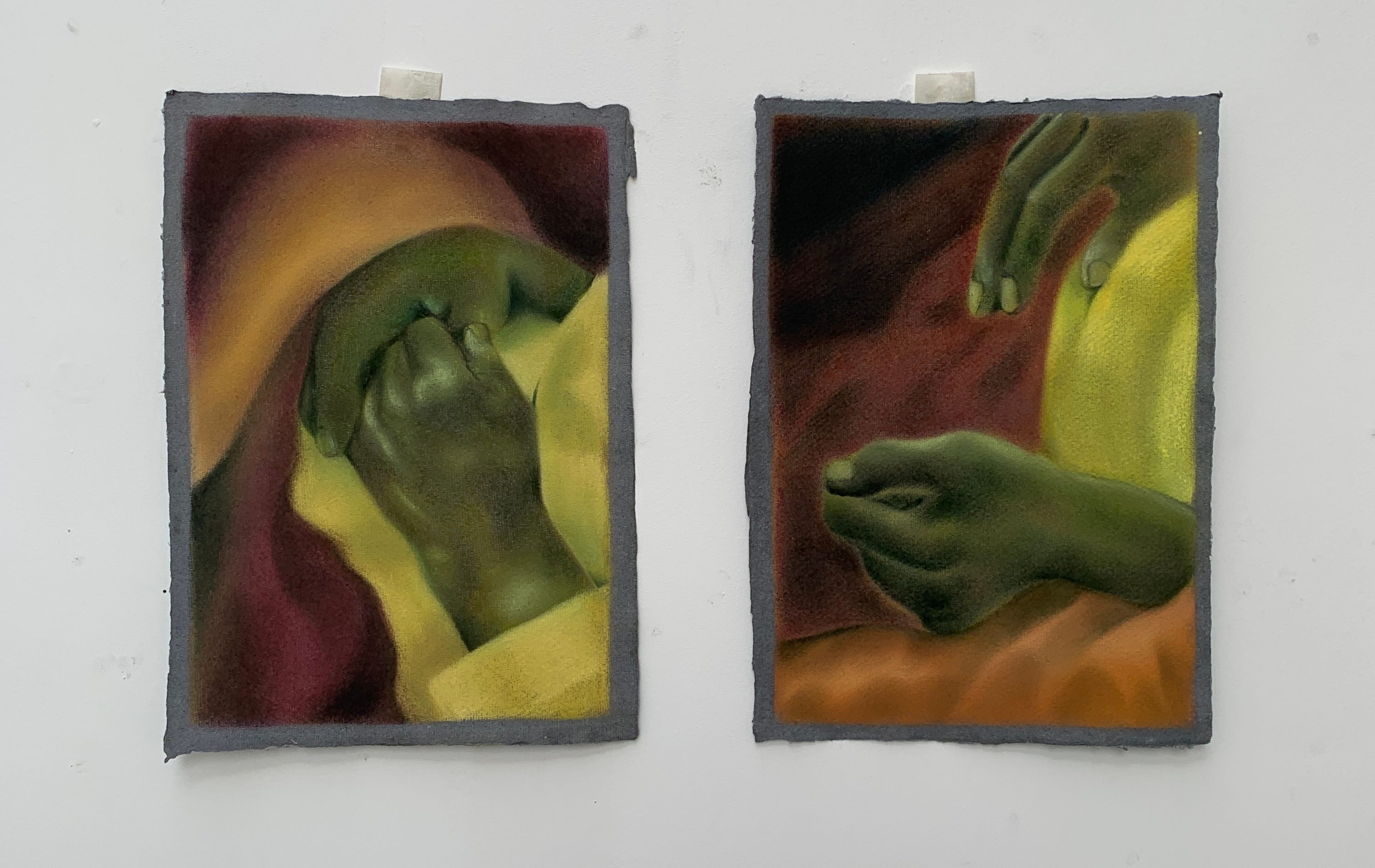
Most of my artwork titles come from conversations I’ve had or heard about and things I’ve read. Skifeee fontasy flim is a nod to a silly family memory that I love. When I told my parents the titles, they immediately burst out laughing and we got to relive that moment again. I work with oral histories and memory, and reminiscing is a big part of my archival review. It brings questions of reliability and record-keeping, that I allow to become part of the work. That brings me on to the question of my family’s response and the other works in the presentation.
One enters a room and history precedes, What does this have to teach us? and One enters a room and history follows are drawn from a book of Polaroid photos that belonged to my Granpa. It includes photos of our family, his friends, himself and his garden patch. He had a board of photos in his living room, but I didn’t discover this book until he passed. Seeing what he selected to display and keep in the book brought up some questions of privacy and perception: what he was happy for anyone to see, what did he keep to himself and why? The same decisions I am in constant dialogue with.
I recently found this article on the ethics of sharing your life as a creative. It speaks to the role of boundaries and vulnerability as a creative and how intimacy becomes a form of currency.
It’s a conversation I’ve had with other artists whose work toes the same line. Part of making intimate work about quiet, personal moments is discussions of consent. When some people hear this, they’re immediately moved to defend the work. “You can’t let their feelings stop you from doing what you need to do!” and I wonder why they can’t hear me when I say it doesn’t.
While I’m grateful that my family are incredibly supportive of what I do, not everything I discover needs to become display. A lot of this work is investigation and those learnings don’t always need to visibly feed what I present. There will be questions that, as an artist, I don’t owe you answers to. You can sit with that ambiguity, face whatever that brings up for you and then realise that my work has done what I set out for it to do. My subject matter is a vessel to steer you into deeper thought about yourself.
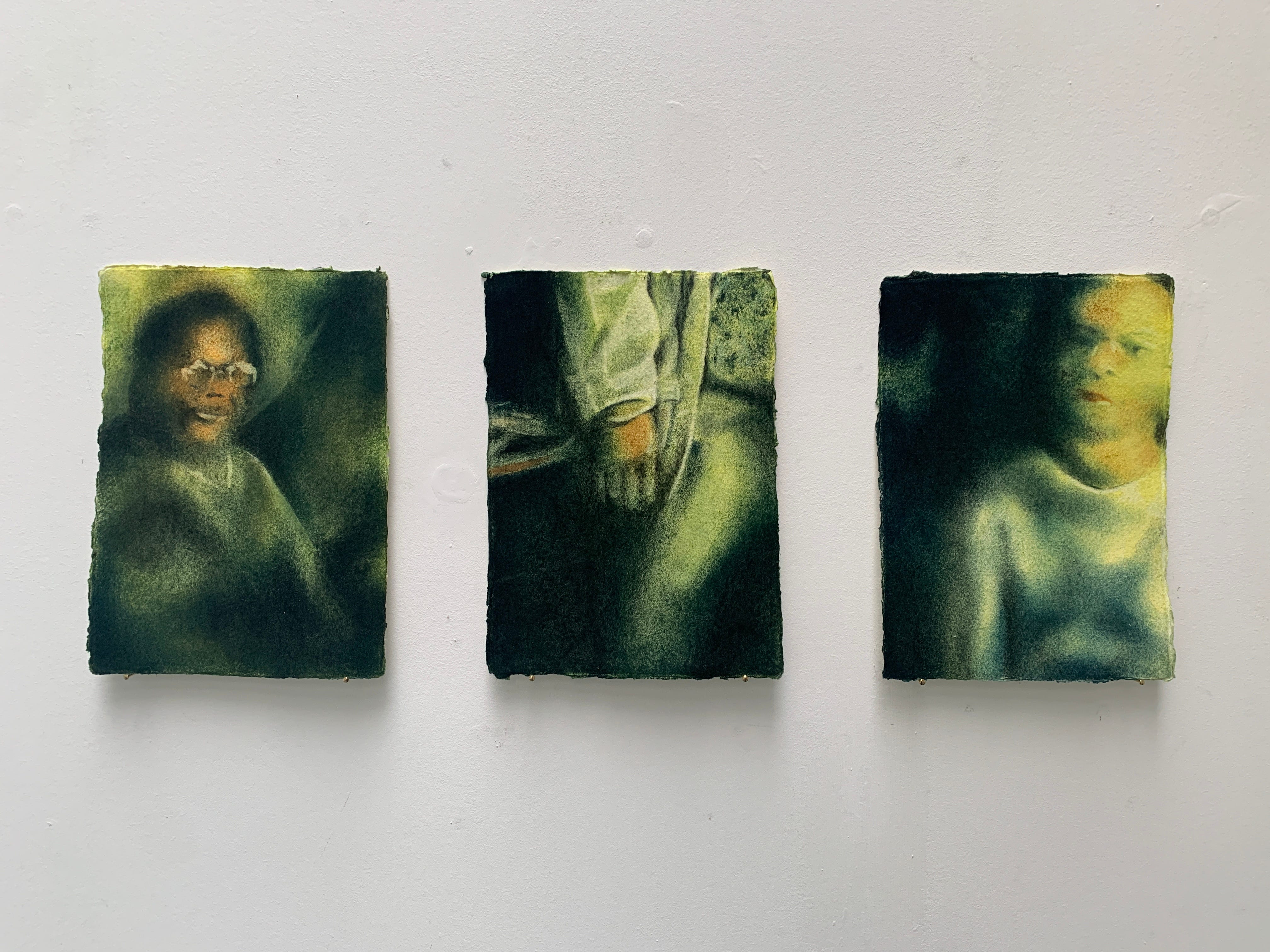
For the ‘One Enters a Room’ drawings, I know some but not all of the people in the photos. It made me think about how memories distort and shift with time if we don’t maintain and preserve our personal archives. A few of the photos are very dark and blurred, probably from my Granpa testing his camera out. This inspired my approach for these drawings, with heavier layering and less definition. I wanted it to feel like you could dive into the drawings despite their size, a bit like sifting through hazy memories.
Ultimately, navigating personal work and everything that comes with it is something I’m constantly refining. There is an element of self-preservation that you barter with as an artist, so I suppose I’m searching for ways to retain balance with that. The work itself is just what I choose to do at any given time. I started this year making work that looked more at my own archive: looking back at photos I’ve taken, studies that never went further etc. I was once told to look at my practice as a constellation of things. Those questions I regularly get asked feed into that, and allow me to expand and retract as I need to. It helps to be reminded that the core purpose of archival work is preservation, and part of that is the archivist treating themselves with the care they extend to the work.
One Enters a Room is on view on Artsy from 6 - 31 March 2026.
The Dot Project presents One Enters a Room bringing together the work of Elizabeth Dimitroff, Isabel Muñoz-Newsome, and Natalie Charles. The presentation examines intimacy as a material condition for Women-Led Galleries Now, Artsy’s Women’s History Month initiative.
To see more of my work, please head to my website ncharles.art or follow me on Instagram @ncharles.art